Plenty of surveyors choose Carlson for a simple reason: you buy the software, you own it. You don’t pay a recurring fee just to keep using it.
Carlson BRx7 vs. Viking GNSS: Field-Tested Comparison for Land Surveyors
The Short Version
For most survey operations, the Carlson BRx7 remains the best value in its class — outstanding RTK performance at a price point that makes equipping a full crew practical. The Viking earns its premium if your workflow depends heavily on tilt compensation accuracy or demands the highest possible confidence in every fixed position.
If you’re running a Carlson BRx7 and wondering whether the new Viking is worth a serious look, we’ve put both units through extensive field testing and dug into Carlson’s technical documentation — including their GAMA RTK White Paper — to give you a straight answer.
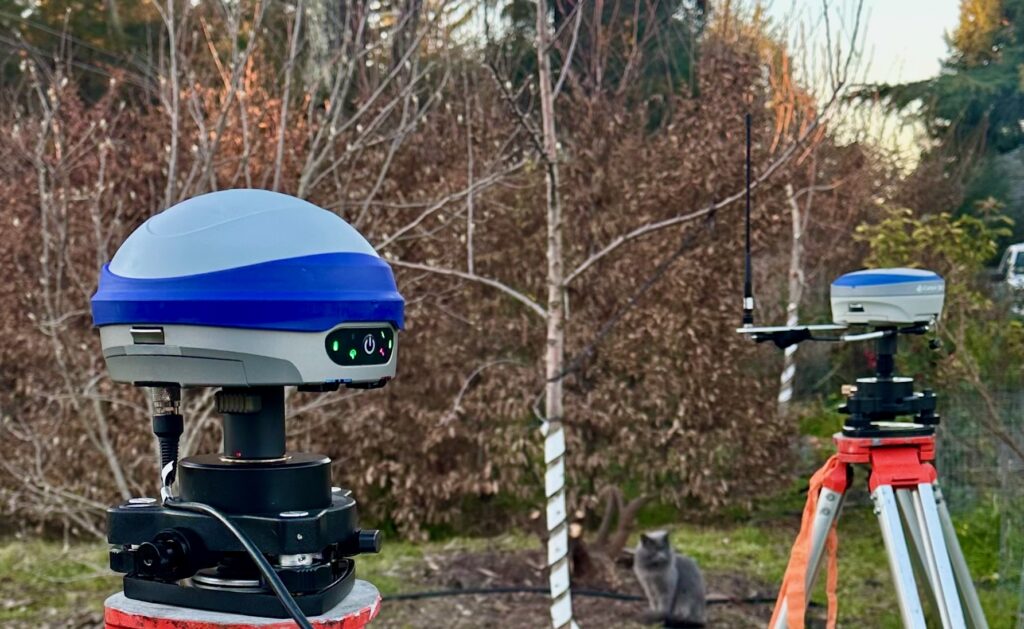
Two Receivers, One Goal
The BRx7 is one of the most trusted GNSS receivers in the industry — a field-proven platform that has earned its reputation job site by job site. The Viking is its successor, designed to match and build upon the BRx7’s strengths. Both are backed by Carlson’s U.S.-based support team, which means whichever unit you choose, you’re covered.
The Viking’s headline technology is its Triple-Fix RTK architecture — dual GNSS receivers combined with three RTK engines running simultaneously. It runs on Septentrio GNSS+ chipsets, bringing a powerful suite of signal protection tools: AIM+ anti-jamming, LOCK+ vibration resilience, IONO+ ionospheric mitigation, and APME+ multipath rejection. Under the hood, it uses Carlson’s new GAMA RTK Engine — a next-generation processing platform with real-time adaptive filtering and advanced Extended Kalman Filters. It’s made in the USA.
How They Actually Perform
In the most difficult conditions — heavy tree canopy, urban canyons, deep signal obstruction — both units performed comparably in our tests. The BRx7 held its own right alongside the Viking, which speaks volumes for a receiver that has been on the market for years.
In intermediate conditions, the results were again largely similar. This is where it’s worth explaining what Triple-Fix actually means in practice: rather than giving the Viking a faster or more aggressive path to a fixed solution, Triple-Fix is fundamentally about reliability and confidence. By running three independent RTK engines simultaneously and requiring agreement across all three before reporting a fix, the Viking provides higher statistical certainty — particularly at the 3-sigma level — that the reported position is correct. It’s a trust mechanism as much as a performance one, and for applications where the cost of a bad fix is high, that matters.
Carlson’s own competitive testing data in the white paper reflects this — the Viking leads the field in both accuracy and fix reliability when benchmarked against top competing brands, with the BRx7 remaining a strong and competitive performer in its own right.
Connectivity and Software
Both receivers share a robust and well-rounded communication suite — UHF radio (400 MHz and 900 MHz), Bluetooth, Wi-Fi, and cellular — along with a web-based interface that makes configuration and monitoring straightforward from anywhere in the field. On the software side, both integrate seamlessly with Carlson SurvPC for data collection, COGO, and stakeout, and both support Carlson SkyNet RTN for network RTK corrections as well as Listen-Listen for flexible cloud-based base/rover operation that isn’t constrained by UHF range.
In terms of satellite tracking, the Viking supports 632 channels versus the BRx7’s 800 channels. Both track GPS, GLONASS, BeiDou, Galileo, QZSS, and NavIC/IRNSS. The practical difference in channel count is minimal for most RTK workflows.
The IMU Tilt Story
This is where the Viking genuinely separates itself. According to Carlson’s published specs, the Viking’s tilt compensation accuracy is roughly twice that of the BRx7, and our field testing confirmed it. At a 30-degree tilt, the Viking delivers 9mm of error versus the BRx7’s 20mm. Push to 60 degrees, and the Viking holds to 15mm while the BRx7 stretches to 50mm.
The Viking’s IMU never requires formal calibration — a meaningful advantage over the BRx7, which does require recalibration any time the receiver is moved to a different pole. The Viking does need a simple wave of the pole to wake and re-initialize the IMU after a period of inactivity, but that’s a quick, intuitive motion rather than a calibration routine. Once active, the system is highly stable and ready to work.
For surveyors who lean heavily on tilt compensation — detail work in tight spaces, stakeout near obstructions, or any situation where plumbing the pole isn’t always practical — that combination of superior accuracy and hassle-free operation adds up meaningfully over the course of a workday.
Who Should Upgrade?
The Viking is a compelling receiver, and its per-unit premium over the BRx7 is easier to justify the more your workflow depends on tilt accuracy or demands the highest possible confidence in every fixed position reported. If either of those describes your work, the Viking earns its price tag.
But for the majority of survey professionals — even those currently running BRx7s — the upgrade case is workflow-specific rather than universal. The BRx7 continues to deliver outstanding RTK performance across virtually all conditions, with the same Carlson support infrastructure behind it and a price point that makes equipping a full crew far more practical.
Our recommendation: the Carlson BRx7 is the best value in its class. It’s not a step behind the Viking in the conditions that define most field work — it’s simply a more efficient investment for most operations.
Talk to Us
If you’re curious whether the Viking’s tilt advantages or Triple-Fix confidence level would translate into a real productivity gain for your specific workflows, give us a call. We know both units inside and out and can help you make the right call for your operation.
Call us at 1-888-299-6996 or email info@carlson-us.com.
Browse the BRx7 | Viking | SurvPC | All Carlson Field Instruments

Related Posts