
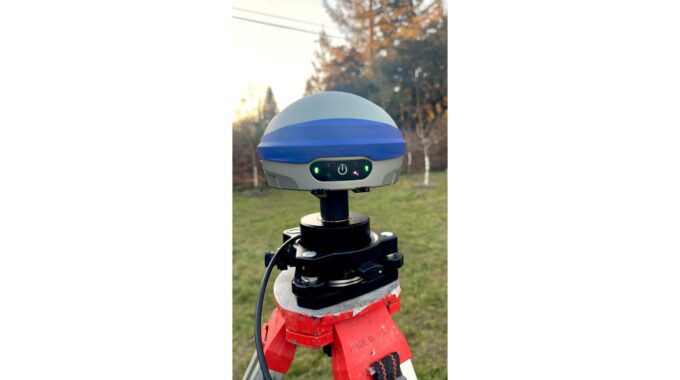
GPS Radio Licensing and Compliance for Surveyors
Before transmitting RTK corrections, confirm that your radio operation is authorized and your settings match that authorization. Buying equipment does not grant permission to transmit. Typical 450-470 MHz survey radios operate under FCC Part 90 and require valid authorization. Low power, remote jobsites and used equipment do not remove that requirement.
Receiving satellite signals or using a receive-only correction radio does not itself require a Part 90 transmitting license. Properly certified license-exempt equipment, such as some 900 MHz systems, follows different rules. Confirm which rules apply to your exact radio and operating mode.
Before your first field transmission
1 Verify authorization. Check the FCC Universal Licensing System for the licensee, active status, expiration date, frequencies, locations or operating area, station classes and special conditions. Do not assume a dealer, rental provider or previous owner’s license covers your operation. Confirm any shared or rental arrangement with the license holder or licensing professional.
2 Obtain or update the license. Use a qualified frequency coordinator or licensing professional when needed. Do not transmit while an application is pending unless you have confirmed that valid temporary or conditional authority applies. Keep a renewal reminder; verify continuing authority before operating after an expiration date.
3 Match the radio to the license. Use only authorized transmit frequencies, emission types, bandwidth and power. Have unauthorized transmit channels removed or disabled. A channel that is clear or preprogrammed is not necessarily yours to use.
4 Check narrowband operation. Part 90 operations in 150-174 MHz and 421-470 MHz generally require 12.5 kHz channels or equivalent efficiency, unless covered by a waiver. A legacy 25 kHz mode is not automatically lawful; equipment capability and license authorization must both support the operation.
5 Configure station identification. Program the assigned FCC call sign and verify identification under 47 CFR 90.425. For typical Industrial/Business operation, identification is required during each transmission or exchange, or at least every 15 minutes of continuous operation, subject to the rule’s exceptions. Use an identification mode permitted by the rule.
6 Protect other radio users. Monitor shared channels and take precautions against harmful interference. Keep required busy-channel protection, often called CSMA or receive priority, enabled and properly configured. Do not defeat it to force corrections through an occupied channel.
7 Check the complete installation. Antenna gain and cable loss affect effective radiated power (ERP); the transmitter’s watt setting alone is not enough. Observe licensed power and geographic limits, including applicable Canadian border conditions. Keep the authorization readily accessible and a copy with the field kit; label the radio with the call sign as a practical check.
Penalties and jobsite consequences
Unauthorized operation, prohibited wideband operation and interference can lead to FCC enforcement, monetary forfeitures and license action. The FCC’s forfeiture guidelines list a $10,000 base amount for operation without authorization. This is a starting point, not a fixed fine or maximum. Actual amounts depend on the facts; continuing violations can increase exposure, subject to applicable statutory limits. Expired-license operation can also trigger enforcement.
Equipment seizure and forfeiture may apply to willful and knowing violations under 47 U.S.C. 510; some violations may also lead to criminal prosecution. Stopping transmissions can interrupt correction service and delay work. If authorization or compliance is uncertain, stop transmitting until the issue is resolved.
Start prepared with Carlson Survey Solutions
Thank you for choosing Carlson Survey Solutions. We provide this guide to help you protect your equipment investment and prepare for responsible field operation. Our team offers knowledgeable, hands-on product support. Bring us your license and radio configuration questions before your first job. The licensee remains responsible for lawful operation.
Contact us 1-888-299-6996 | info@carlson-us.com | carlson-us.com
Official references 47 CFR 90.403, 90.425 and 90.437 (operation, identification and authorization access); 47 CFR 1.80 (forfeitures); 47 U.S.C. 301,501, 503 and 510. Current rules: ecfr.gov/current/title-47. FCC narrowband guidance: DA 16-36. License lookup: FCC Universal Licensing System. Prepared October 2026. General guidance for U.S. operation; your FCC authorization and applicable rules control. Confirm requirements before use and when changing equipment, settings or operating locations.
